Hard water can create persistent operating problems in industrial facilities, commercial buildings, hotels, institutions, plus residential developments. A Water Softener Plant is designed to reduce hardness-causing ions, helping limit scale formation in equipment plus water-distribution systems.
Across Delhi NCR, groundwater can vary considerably in hardness. Facilities relying on borewell water or mixed water sources may therefore need to evaluate hardness before deciding whether softening is appropriate.
What Causes Water Hardness?
Water hardness is mainly associated with dissolved calcium plus magnesium ions.
When hard water is heated or concentrated, mineral deposits can form on surfaces. These deposits are commonly known as scale.
Scale may accumulate in:
- Pipelines
- Heat exchangers
- Boilers
- Hot-water systems
- Cooling-related equipment
- Process equipment
- Fixtures
The severity depends on water chemistry, temperature, operating conditions, plus equipment design.
How Water Softening Works
Many industrial softeners use ion-exchange resin.
As hard water passes through the resin bed, hardness-causing ions are exchanged for sodium ions. Eventually, the resin becomes exhausted plus requires regeneration using a brine solution.
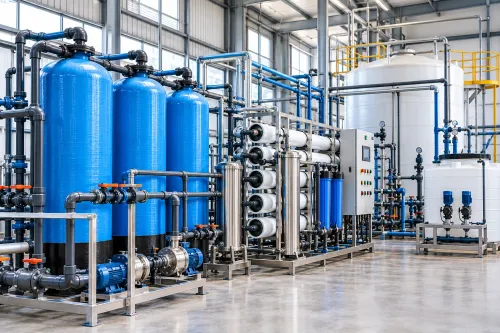
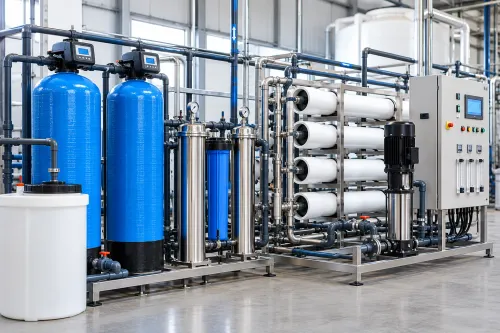
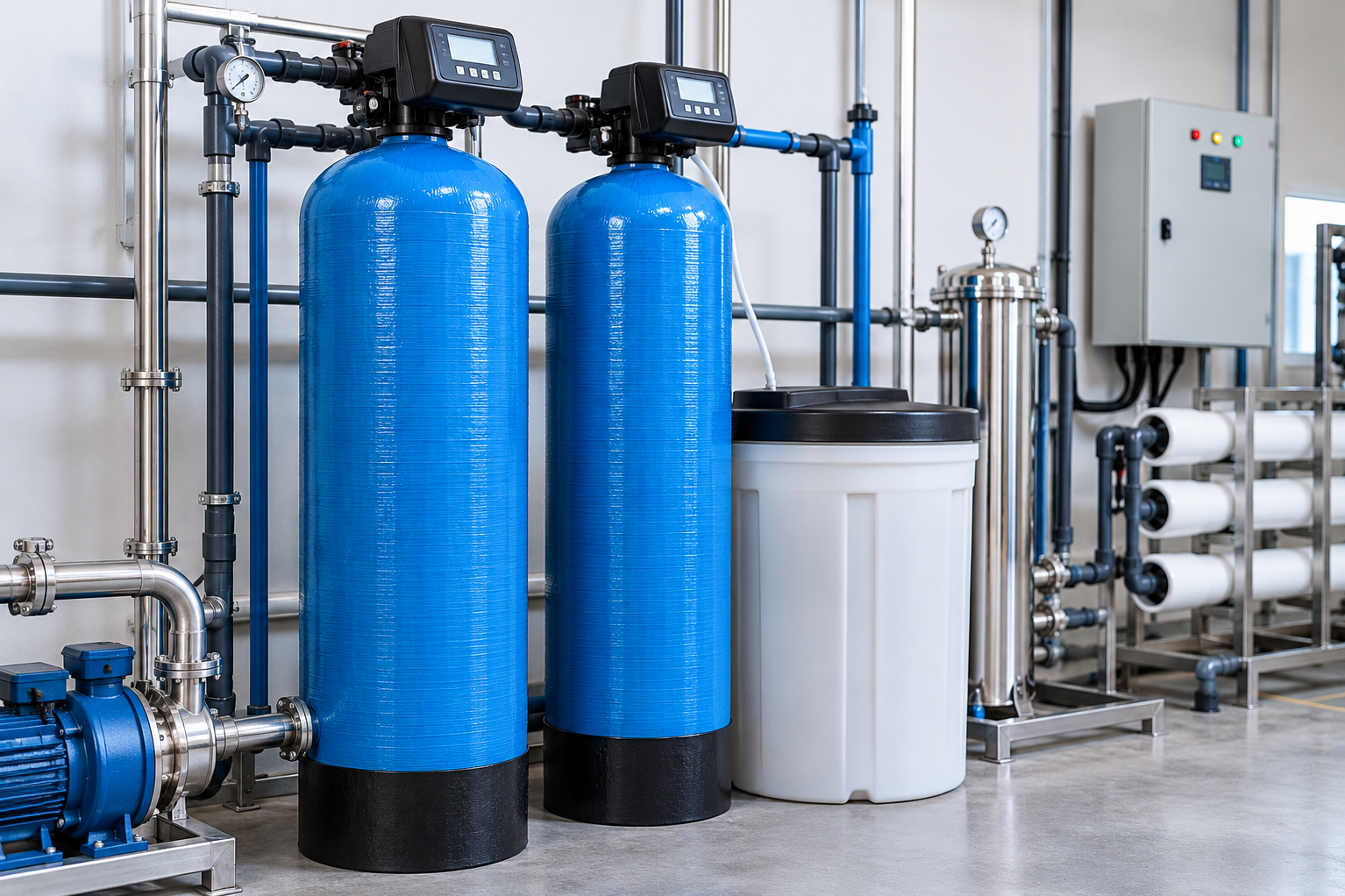
A typical softening system can include a pressure vessel, resin media, control valve, brine tank, plus associated piping.
Larger facilities may use automated configurations depending on water demand plus operating requirements.
Reduced Scaling Can Protect Equipment
Scale creates an insulating layer on heat-transfer surfaces.
Where heat transfer is important, this can reduce efficiency plus increase operational stress.
Deposits can also restrict pipeline flow, interfere with valves, plus increase cleaning requirements.
Reducing hardness before water enters sensitive equipment can therefore support more consistent operation.
Softening Can Support Downstream Treatment
A Water Softener Plant may also be used as pretreatment before certain downstream water-treatment processes.
For example, hardness can contribute to scaling in RO systems. Depending on feed-water chemistry plus RO design, softening may be considered as one strategy for controlling hardness before membrane treatment.
The decision should be based on a complete water analysis.
Capacity Should Reflect Hardness Load
Softener sizing involves more than litres per hour.
The designer needs to consider both flow plus the quantity of hardness entering the system.
Higher hardness means resin capacity may be exhausted more quickly, resulting in more frequent regeneration.
Key inputs include:
- Raw-water hardness
- Required treated-water hardness
- Daily consumption
- Peak flow
- Resin capacity
- Regeneration frequency
- Available regeneration time
Ignoring these factors can lead to inconsistent softened-water quality.
Operating Costs Need Consideration
A softener uses salt for regeneration plus water for the regeneration cycle.
Facilities should estimate salt consumption, regeneration-water requirements, operator involvement, plus maintenance needs before installation.
Automation can simplify operation, particularly where water demand is high or continuous.
NEEL GUARD AQUA SYSTEMS supports water-treatment projects for industrial, commercial, institutional, plus residential applications across Delhi.
A Water Softener Plant can be valuable where hardness is contributing to scale, maintenance, or downstream treatment problems. However, the decision should begin with testing rather than assumptions.
Measure hardness first, review the application, determine daily water demand, then evaluate the required softener capacity plus regeneration strategy.
This approach helps ensure that the system addresses a genuine water-quality problem while remaining practical to operate over the long term.
Keywords